


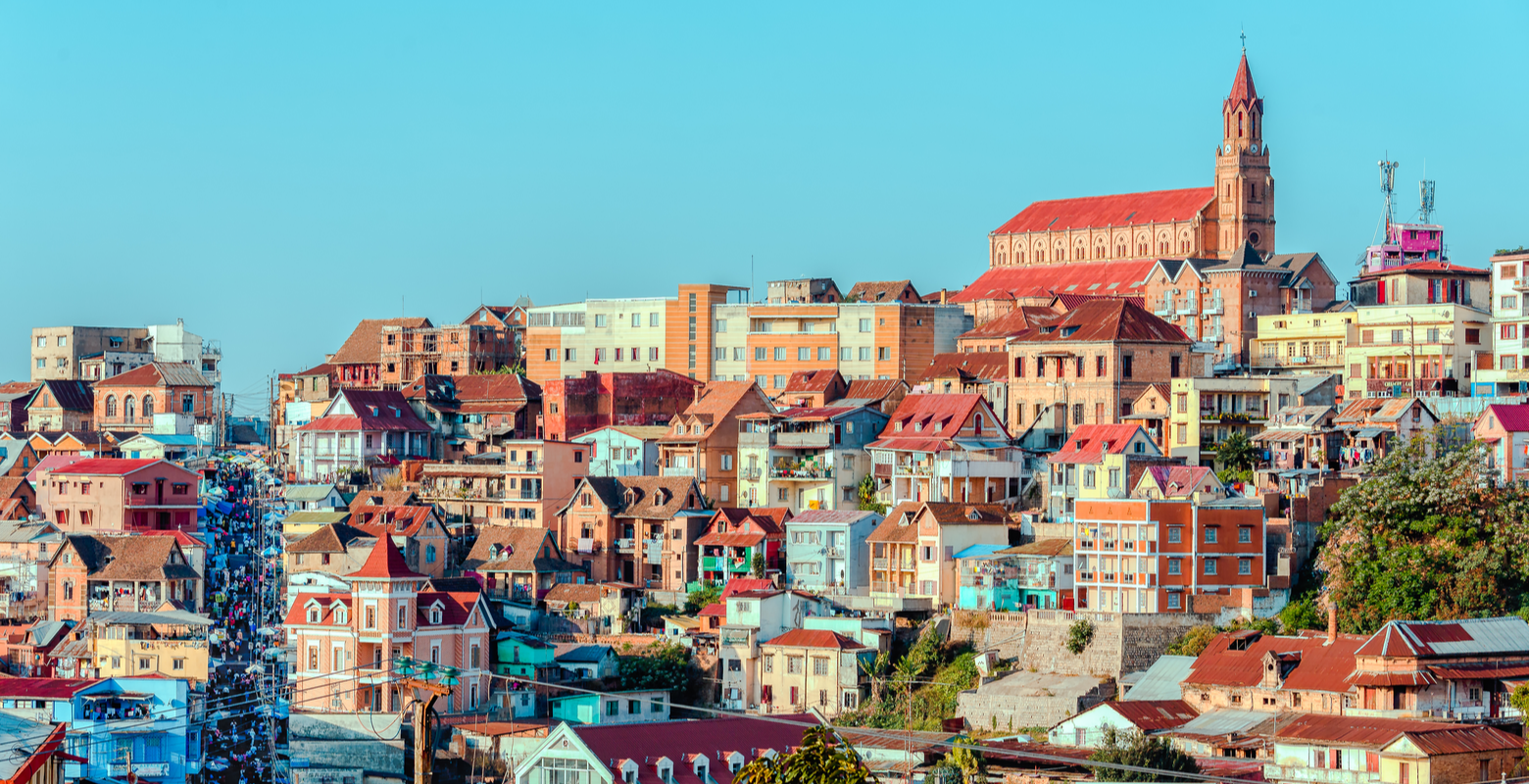
Known as the largest and busiest city in all of Madagascar, chances are Antananarivo will be your very first stop when visiting this island country. Read on to learn why.
The City of the Thousand
Nestled very high up on a plateau that overlooks the Betsiboka and Ikopa Rivers, the city of Antananarivo covers an overall land area of 8,640 hectares and is deemed as Madagascar’s cultural, economic, judicial, communications and administrative center.
It also goes by the name of “Tana,” which is what the French colonizers called it when they occupied the country.
Formerly known as Tananarive, this bustling city was established in 1625 by the Merina King Andrianjaka to cap off the tribe’s aggressive expansion that started from the country’s vast central highlands. This area also served as the seat of power for other Malagasy nobles until the 19th century.
The name “Antananarivo” directly translates to the “city of a thousand,” which roughly describes the number of soldiers that King Andrianjaka ordered to stand guard and protect its perimeters and inner sectors from rival warriors.
Moreover, the plateau where this city of more than 3 million inhabitants stands has a total elevation point of 4,199 feet above sea level. This makes it the world’s highest national capital as regards to altitude compared to all other island nations.
The Upper Town, the Middle Town and the Lower Town
Besides being clues as to their particular geographical positions with one located up a hill, the other in the middle and another set below its slopes, Antananarivo’s Upper Town, Middle Town and Lower Town are the main sectors that comprise this city’s premises.
The Rundown on the Lower Town
Deemed as the more populated and livelier sector of Antananarivo, the Lower Town or — La ville basse — is the place where most of the city’s hotels, commercial buildings and similar establishments are concentrated.
This part of the city got its name from the urban and industrial expansion that took place in the area’s lower districts during the French occupation in 1894.
The expansion began from the base of Antananarivo’s central hills and went all the way down to the low-lying rice fields that surrounded its borders.
Apart from being the place where the historical Avenue of Independence is located, the Lower Town also houses the Soarano Train Station or Gare de Soarano, which used to be the city’s main train terminal.
According to local folk history, the Soarano Train Station was constructed in 1908 and was named after a water fountain situated near its entrance. This fountain always provided fresh, cool water to the travelers coming from and going to the station.
The Malagasy term “soarano” directly translates to “good water.” While neglected to a point for some time, the Soarano Train Station was eventually renovated in 2009 and turned into a shopping complex that contains a popular restaurant called the Café de la Gare.
This popular dining spot which has gathered quite a following for its sumptuous lineup of Malagasy and European fares.
A Brief Walkthrough of the Upper Town
The Upper Town — also known as La haute ville — is where you get to see most of Antananarivo’s historical landmarks and architecture.
Besides catching a glimpse of the Andafiavaratra Palace, which was built in 1873 by Prime Minister Rainilaiarivony, and an ancient courthouse, you’ll also get to see the Rova or the Queen’s Palace.
If you explore the area a bit further, you can check out the Bibliothèque Nationale, an observatory as well as a number of research institutes.
This part of Antananarivo can be accessed by going past the Ambohijatovo and Analakely markets, which are the areas that mostly make up the Middle Town or La ville moyenne, then hiking up the 4,694-foot rocky ridge that leads up to the Royal Estate.
You will also pass several 19th-century traditional Malagasy houses called trano gasy along the way.
About halfway through, you can check out the residence of the French early industrialist and adventurer, Jean Laborde, who played a key role in the further strengthening of the Merina monarchy under the leadership of Queen Ranavalona I.
If you visit the Upper Town during summer, you’ll also see lots of jacaranda trees flaunting their purple flowers.
The Climate and Weather in Antananarivo
Antananarivo is classified as having a subtropical highland climate, an atmospheric pattern that is characterized by warm yet rainy summers and cold winters.
The average daily temperature in the city is a balmy 20.8 degrees Celsius, but sweltering temperatures as high as 32 degrees Celsius have been recorded between the months of January and June.
As for its winter season that runs from May to October, Antananarivo often experiences temperatures as low as 0 degrees Celsius during this time.
While frosts rarely take place in the city itself, they are quite common in the neighboring highlands. Moreover, the city has most of its rain showers from November to April and receives an annual rainfall level of about 3.6 feet.
Highlights You Shouldn’t Miss
The Avenue of Independence
Deemed as Antananarivo’s main thoroughfare, the Avenue of Independence (French: Avenue de l’Indépendance) is the city’s most energetic and vibrant area. It is approximately a kilometer long and flaunts several shopping arcades on both sides, which are separated by a strip of greenery in the middle.
This avenue was constructed by the French in the 1930’s and passes along the Soarano Train Station and an assortment of stores selling anything from meats, vegetables, fruits, jewelry, fabrics and other sorts of merchandise.
Its original name was Avenue Fallières, but was later changed to Avenue de la Liberation. After Madagascar gained independence from French rule on June 26, 1960, it was eventually named the Avenue of Independence as a nod to the momentous historical event.
These days, the Avenue of Independence is considered as an essential shopping destination for tourists for its variety of shops, cafes, restaurants and boutiques that line the area. You’ll also find banks and airline ticketing offices along its stretch.
Interestingly, the Avenue of Independence eventually intersects a boulevard called the Street of 26th June 1960 just before you reach the Zoma market. It was also named after the country’s historic day of decolonization.
The Rova of Antananarivo
The Rova of Antananarivo is set on the city’s highest hill, Anamalanga, and used to be the residence of the nobles and rulers of the Imerina Kingdom in the 17th and 18th centuries.
It also became the royal palace complex of the Madagascar monarchy up until the 19th century when the island nation was declared a protectorate of France.
Local history has it that when the Merina King Andrianjaka captured the city of Antananarivo from the Vazimba, a Malagasy ethnic group that is believed to be composed of pygmies, he ordered the construction of a royal fortified structure or rova to strengthen his claim.
During Andrianjaka’s reign, he built three separate structures, namely the Besakana, which translates to “very wide” and was said to be the place where the king lived.
He also built the Masoandrotsiroa, which translates to “there are no two suns,” as well as the Trano masina fitomiandalalana, which translates to “seven holy houses in one line” and served as his tomb when he died.
While the Rova of Antananarivo is seen as a symbol of victory for King Andrianjaka, it is deemed as a place of defeat for Queen Ranavalona III.
She surrendered when the occupying French military fired a cannon shell that ripped through one of its buildings and fatally injured lots of people in September 1894.
Locals often say that the Rova of Antananarivo is one of the hardest places to miss in the city — even if one tried really hard — given its lofty position on the Anamalanga hill.
Although most of the wooden structures in the palace complex were ravaged by a fire in 1995, the stone building designed by Scottish missionary, James Cameron, in 1867 still stands proudly.
The Thousand Steps of Tana
The Thousand Steps of Tana is a slightly steep and continuous passageway that links Antananarivo’s Upper, Middle and Lower towns. It features two distinct concrete stairways that begin from Ambondrona and Analakely and culminate in the Zoma market.
And while we are on the subject, the Malagasy term “Zoma” directly translates to “Friday.” The Zoma market basically gets its name from the numerous stalls and kiosks set up during Antananarivo’s traditional market day, which is held during Fridays.
The Thousand Steps of Tana has a total length of 4,694 feet and can be a bit tricky to climb during noontime and in the early afternoon when the sun’s rays are going to be pretty harsh.
Additionally, Antananarivo’s tourism office, the Office Régional du Tourisme d’Antananarivo or ORTANA, is also conveniently located at its base.
The Musée d’Art et d’Archéologie
The Musée d’Art et d’Archéologie is a small museum located in Antananarivo that showcases an array of ancient finds all over Madagascar as well as the specific locations they were excavated from. Visitors can get inside free of charge.
Apart from having numerous displays of objects used in traditional ceremonies such as talismans and trinkets, this modest museum also features many cooking utensils, musical instruments and even grave decorations from different ethnic groups in the country.
Some Notable People Born in Antananarivo
What’s really interesting is that there are a few Antananarivo natives who have acquired international acclaim over the years.
These include folk and blues guitarist, Randriamananjara Radofa Besata Jean Longin, also known by his stage name “Madagascar Slim,” professional tennis player Natacha Randriantefy, Olympic hurdler Nicole Ramalalanirina, and French novelist Claude Eugène Henri Simon.
Recommended Activities
Conquer the Thousand Steps of Tana.
Sure just thinking about hiking this 4,694-foot long concrete stairway can be already quite exhausting, but conquering the Thousand Steps of Tana is a must if you’re really looking to experience Antananarivo’s bustling sights and sounds firsthand.
While the journey up involves negotiating a steep, continuous path, you can always take a break every few meters or so when you feel winded. There are also lots of exciting things to see during the walk up like colorful traditional lambas as well as unusual fruits and vegetables, so you will never get bored.
Check out the Avenue of Independence.
Described by the locals as Antananarivo’s “main artery,” it is said that you can’t claim to have explored the city’s downtown area until you’ve finished getting around the Avenue of Independence.
Having a profusion of shops, eateries, banks and other commercial establishments, you can either drop by the area for leisure or business.
Most of the city’s airline ticketing offices are situated in this place so chances are you’re going to have to pass through this avenue if you need to arrange flights to other parts of Madagascar.
Marvel at the Rova of Antananarivo.
Besides getting the most amazing views of the city, visiting the Rova of Antananarivo also gives you the opportunity to admire the old royal structures that used to stand gallantly on the hill of Anamalanga.
You’ll have to pay a small fee to be allowed access to the Rova’s grounds as well as a customary tip for the guide who will take you around the place.
Most of these guides are usually college students who are fluent in French and English so you don’t have to worry about the language barrier.
Sample local dishes at the Café de la Gare and La Buffet du Jardin
The Café de la Gare and La Buffet du Jardin are two of the most popular dining establishments in Antananarivo and they’re quite known for their mouth-watering menu of Malagasy and European dishes.
The Café de la Gare is located in what used to be the old Soarano Train Station and has already gathered quite a following for its classy period architecture, cozy ambiance as well as its tasty offerings like sauteed lobster tails and zebu meat with a sauce made from green peppers.
Its kitchen is headed by Bruno Waha, also known as “Chef de Gare” and is often described as the go-to place if you’re in the mood for European favorites with a Malagasy touch.
On the other hand, La Buffet du Jardin is very famous for its crispy pizzas that combine local ingredients with European culinary techniques. These crunchy treats go very well with the locally brewed pale lager called the Three Horses Beer).
Moreover, La Buffet du Jardin has live music on Thursdays, Fridays and Saturdays. Tourists who have already checked out this dining place also relate that its brewed coffee is quite delicious and is a hit among locals and visitors alike.
Go over the merchandise in Village Artisanal d’Andohalo
Jardin d’Andohalo is basically a park that’s surrounded with various shopping centers in Antananarivo’s downtown area. One of these is the Village Artisanal d’Andohalo, which features many local traditional products that range from handmade jewelry to table mats and many more.
There are lots of merchandise to check out in the Village Artisanal d’Andohalo, especially if you’re looking to score some awesome souvenirs and presents to take home. This place even has beauty products made from very fragrant flowers called Ylang ylang, which have a deep, rich aroma.
Getting Around
There are three ways to get around the city of Antananarivo and these are navigating its streets on foot, riding the bus as well as taking a taxi.
If you’re looking to significantly cut your expenses when visiting Madagascar’s capital, then exploring the place on foot is the most practical of all the options since although this city is quite large and very sunny, there are lots of trees in the area that offer shade while you walk.
However, if you’re not a fan of negotiating steep slopes and descents, which Antananarivo is simply loaded with, it is highly recommended that you go for another option.
On the other hand, city buses called “taxi-be” are the most affordable means of transportation in Antananarivo. Most of these “buses” are actually vans that are converted to accommodate as many people as possible.
While riding a bus or taxi-be is way cheaper than taking a cab and much more convenient than walking, you should be prepared to be squeezed in with lots of other people and their various luggage.
In Madagascar, “luggage” could mean anything from the usual traveling bag to a chicken or two. It is also customary to wait for the bus to be filled up with passengers, which can take from a few minutes to an hour.
A lot of tourists who have already visited Antananarivo relate that taking a taxi is the most trouble-free option to get around the city. You simply have to get in the cab, tell the driver where you’re going and you’ll reach your destination soon.
However, it is crucial to negotiate with the driver as regards to the fare before entering the taxi to avoid confusion and delay. The rates are also going to be double or even triple than that of a bus or taxi-be.
It is also important to take note that it is very likely that you are going to be stuck in traffic when you reach Analakely during the rush hour. Being Antananarivo’s busiest commercial spot, it is not uncommon for vehicles of all kinds to pass through this area at this time.
Quick Reminders
Travel inconspicuously.
When exploring Antananarivo, make sure you go for simple clothes that don’t make you a potential target for thieves and pickpockets. While security is a bit of an issue in the city, you can prevent any untoward incidents by choosing your outfit carefully.
On a similar note, remember to avoid wearing jewelry and similar expensive accessories when going around the capital.
According to local news reports, the hotspots for snatching and pickpocketing are usually concentrated in and around the areas of Analakely and the Thousand Steps of Tana where it is not uncommon to have lots of people gathered in one place simultaneously.
If you’re looking to snap some pictures using a camera or your phone, make it a point to hold your device as close to your body as possible. Use a sling bag to put your wallet in. It is also highly recommended to only bring a minimal amount of money when getting around Antananarivo.
Choose open and well-lit routes.
Always go for open and well-lit routes when walking the streets of Antananarivo. Thieves and pickpockets usually lurk in areas where they can just wait and surprise their would-be victims.
It is also highly recommended that you consult the personnel at the tourism office or a police officer if you’re unsure of the route to take to get from one area to another. It is also quite easy to get lost in a city as large as Antananarivo.
Remember to tip.
Akin to other parts of Madagascar, it is deemed customary to tip in Antananarivo. Make sure you always give a bit of gratuity to tour guides, waiters, drivers, bellhops and similar service providers when you’re in the area.
Moreover, if you’re uncertain whether you have to tip or not, make it a point to ask the person providing the service himself or herself to avoid confusion and awkwardness.